Polysorbate 20 vs Polysorbate 80: Key Differences, Properties, Applications & Selection Guide
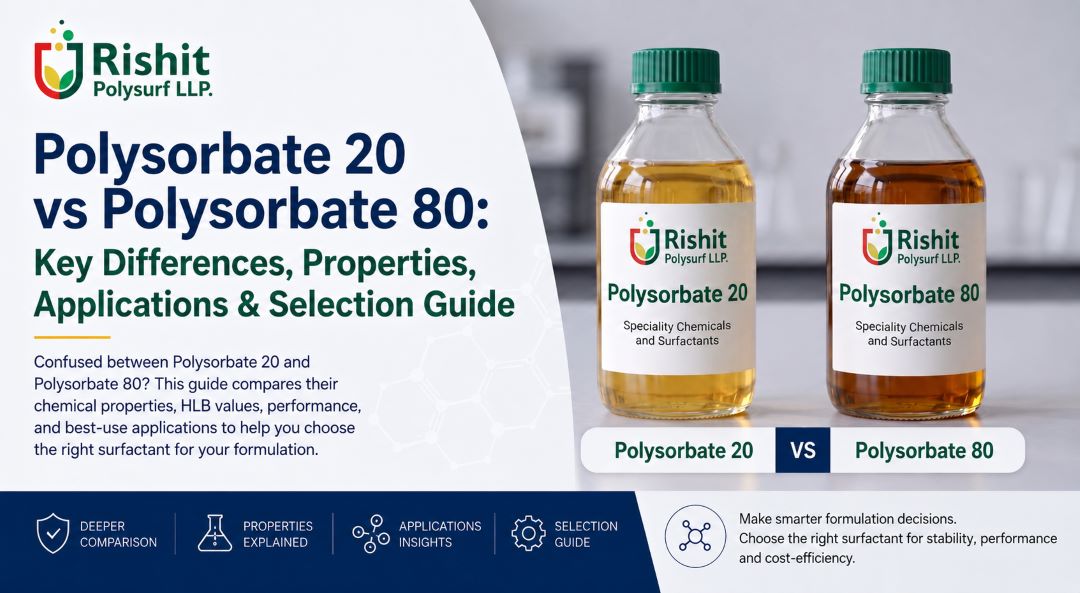
For anyone specifying emulsifiers for a formulation — food, pharmaceutical, cosmetic, agrochemical, or industrial — Polysorbate 20 and Polysorbate 80 show up on almost every shortlist. Both are nonionic surfactants derived from ethoxylated sorbitan esters, both carry a high HLB value suited to oil-in-water systems, and both appear across overlapping regulatory and industry categories. That overlap is exactly why the two get compared so often, and why "Polysorbate 20 vs Polysorbate 80" is one of the most common technical questions procurement teams and formulation chemists raise before finalizing a spec sheet.
The two are not interchangeable, though. The difference sits in the fatty acid each is built from — lauric acid for Polysorbate 20, oleic acid for Polysorbate 80 — and that single structural distinction drives measurable differences in HLB, oil compatibility, oxidative stability, and where each performs best. Picking the wrong one rarely causes total formulation failure; it more often shows up later, as a clarity problem, a stability issue during shelf-life testing, or an emulsion that separates under real-world storage conditions.
This guide compares Polysorbate 20 and Polysorbate 80 on chemistry, HLB, performance, and application, so formulators, procurement managers, and manufacturers can select the correct nonionic surfactant with confidence rather than by default. For broader context on this surfactant class, see our Nonionic Surfactants Guide.
What is Polysorbate 20?
Polysorbate 20 is the INCI and pharmacopeial name for polyoxyethylene (20) sorbitan monolaurate, CAS number 9005-64-5 (also known by the widely used trade name Tween 20, a registered trademark of Croda International Plc). It is a nonionic surfactant manufactured by esterifying sorbitan — derived from sorbitol — with lauric acid, then ethoxylating that ester with approximately 20 moles of ethylene oxide. The result is a four-arm, PEG-based molecule with a lauric acid group capping one arm, giving Polysorbate 20 an average molecular weight of roughly 1,228 g/mol and a hydrophile-lipophile balance (HLB) of approximately 16.7 — among the highest of any commercial polysorbate grade.
That high HLB places Polysorbate 20 firmly in oil-in-water emulsifier and solubilizer territory rather than water-in-oil. In practice, this makes it especially effective at pulling small amounts of oil-soluble material — essential oils, fragrance oils, light esters, oil-soluble vitamins — into a clear or near-clear aqueous phase, which is why it is the default solubilizer in a large share of essential-oil-based formulations.
Polysorbate 20 shows up across personal care and cosmetic formulations, pharmaceutical excipient use (including as a stabilizer in biologic drug products), food emulsification (listed under food additive number E432), agrochemical emulsifiable concentrates, textile wet-processing auxiliaries, and industrial cleaning formulations, where it functions as a co-surfactant that helps disperse oily soils. Because it carries no ionic charge, it remains functional across a wide pH range and blends predictably with anionic, cationic, and amphoteric surfactants in the same system — a practical advantage when balancing a multi-surfactant formulation. Full technical specifications and supply details are available on our Polysorbate 20 product page.
What is Polysorbate 80?
Polysorbate 80 is the INCI and pharmacopeial name for polyoxyethylene (20) sorbitan monooleate, CAS number 9005-65-6 (widely known by the trade name Tween 80). Structurally, it is built the same way as Polysorbate 20 — sorbitan esterified with a fatty acid, then ethoxylated with roughly 20 moles of ethylene oxide — except the fatty acid here is oleic acid, an 18-carbon monounsaturated chain rather than the 12-carbon saturated lauric acid used in Polysorbate 20. That longer, unsaturated chain gives Polysorbate 80 a slightly higher average molecular weight (around 1,310 g/mol, against roughly 1,228 g/mol for Polysorbate 20) and an HLB value of approximately 15 — still a high-HLB, oil-in-water emulsifier, just marginally less hydrophilic than its counterpart.
The oleic acid backbone is what defines Polysorbate 80's practical behavior: it gives the molecule stronger affinity for heavier, less polar, and solvent-type oil phases than the shorter, saturated Polysorbate 20. That is the reason Polysorbate 80 is the more common choice in agrochemical emulsifiable concentrates, crop-oil adjuvants, and formulations built around mineral-oil or vegetable-oil carriers — systems where a shorter-chain emulsifier offers weaker interfacial anchoring.
Beyond agrochemicals, Polysorbate 80 is widely used in cosmetic and personal care emulsions, industrial cleaners and degreasers, textile-processing auxiliaries, and food emulsification (food additive number E433). It also has a distinct pharmaceutical footprint: alongside Polysorbate 20, it is one of the two surfactants most commonly used to stabilize therapeutic proteins in biologic drug products, and it is used in oral liquid formulations as a solubilizer and suspension stabilizer. Parenteral and vaccine-grade use carries stricter pharmacopeial and purity requirements than general industrial use, so that application should always be confirmed against compliance-specific documentation. Full specifications and supply options are on our Polysorbate 80 product page.
Polysorbate 20 vs Polysorbate 80 Comparison Table
The table below summarizes how Polysorbate 20 and Polysorbate 80 compare across the properties formulators and procurement teams typically evaluate.
| Property | Polysorbate 20 | Polysorbate 80 |
|---|---|---|
| Chemical Name | Polyoxyethylene (20) Sorbitan Monolaurate | Polyoxyethylene (20) Sorbitan Monooleate |
| CAS Number | 9005-64-5 | 9005-65-6 |
| Source Fatty Acid | Lauric acid (C12, saturated) | Oleic acid (C18, monounsaturated) |
| Average Molecular Weight | ~1,228 g/mol | ~1,310 g/mol |
| Appearance | Yellowish to amber, oily clear liquid | Oily, yellowish to brownish-yellow clear liquid |
| HLB Value | ~16.7 | ~15.0 |
| Water Solubility | Fully water-soluble | Fully water-soluble |
| Oil Compatibility | Best with light, low-polarity oils (essential oils, light esters) | Better affinity for heavier, less polar oils and solvent-type carriers |
| Viscosity (25°C) | ~300–430 mPa·s, grade-dependent | ~400 mPa·s |
| Typical Dosage | 0.1–5%, formulation-dependent | 0.1–5%, formulation-dependent |
| Emulsification Strength | Strong O/W emulsifier; favors light oil phases | Strong O/W emulsifier; favors broader, heavier oil phases |
| Foaming | Mild to moderate, typical of nonionics | Mild to moderate, typical of nonionics |
| Storage Stability | Good under normal storage; saturated chain resists oxidation | Good under normal storage; unsaturated chain is more oxidation-sensitive — protect from heat, light, and air |
| Essential Oils | Preferred solubilizer | Usable; generally secondary to Polysorbate 20 |
| Fragrance Solubilization | Very good for light fragrance oils | Very good, including heavier fragrance blends |
| Cosmetics | Widely used | Widely used |
| Pharmaceuticals | Excipient; oral, topical, biologic stabilizer | Excipient; oral, topical, biologic and parenteral use |
| Food | Approved additive (E432) | Approved additive (E433) |
| Industrial Cleaners | Light-duty co-surfactant | Common in heavier-duty degreasing systems |
| Agriculture | Used in some EC systems | Preferred in agrochemical EC and adjuvant systems |
| Suitable Formulations | O/W emulsions, clear solubilized systems, light-duty cleaners | O/W emulsions, agrochemical EC, heavier oil systems, parenteral formulations |
Values represent typical, generally accepted reference figures. Batch-to-batch and grade-to-grade variation is normal in surfactant manufacturing — always confirm exact figures against the current Technical Data Sheet (TDS) and Certificate of Analysis (COA) before finalizing a specification.
HLB Comparison
HLB (Hydrophile-Lipophile Balance) is the single most practical number a formulator has for predicting how an emulsifier will behave, and it's usually the first filter applied when narrowing down a surfactant shortlist. The scale runs roughly from 0 (fully lipophilic) to 20 (fully hydrophilic): emulsifiers around 3–6 favor water-in-oil systems, 7–9 tends to indicate a wetting agent, 8–18 covers oil-in-water emulsifiers, and 15–18 is where solubilizers sit. For a deeper explanation of how the scale works and how it's calculated, see our guide to HLB Value Explained.
Polysorbate 20's HLB of approximately 16.7 and Polysorbate 80's HLB of approximately 15 both sit inside the oil-in-water and solubilizer range, which is why either can technically stabilize an O/W emulsion — but the gap between them is enough to matter in practice. Polysorbate 20's higher HLB makes it more efficient at solubilizing very small, polar oil loads, such as a fraction of a percent of fragrance oil in a clear toner. Polysorbate 80's slightly lower HLB, combined with its oleic acid tail, gives it more effective interfacial anchoring against larger or less polar oil phases.
In practice, formulators rarely rely on a single emulsifier's HLB value in isolation. A common approach is to calculate the required HLB of the oil phase — each oil has its own required HLB, either published or determined experimentally — and then blend a high-HLB polysorbate with a lower-HLB co-emulsifier, such as a sorbitan ester, until the blended system matches that target. A lotion built around mineral oil, for instance, might combine Polysorbate 80 with a low-HLB sorbitan ester in a defined ratio to hit the oil's required HLB precisely, rather than relying on either surfactant alone.
Chemical Structure Differences
Both Polysorbate 20 and Polysorbate 80 share the same basic architecture: a sorbitan core derived from sorbitol, with polyethylene glycol chains grown from it, and a single fatty acid ester capping one of those PEG arms. The polyoxyethylene portion — approximately 20 moles of ethylene oxide — is essentially identical between the two. The entire behavioral difference between them comes down to which fatty acid is esterified onto that structure.
Polysorbate 20 uses lauric acid, a fully saturated 12-carbon chain with a straight, compact geometry. Polysorbate 80 uses oleic acid, an 18-carbon chain with a single cis double bond partway along its length, which puts a permanent kink in the molecule rather than a straight tail.
That geometric difference has two practical consequences. First, the straight lauric chain in Polysorbate 20 packs more efficiently against small, polar, low-molecular-weight oils, which is why it excels at solubilizing essential oils and light esters. The bent, longer oleic chain in Polysorbate 80 sits more comfortably alongside bulkier, less polar oil molecules, giving it stronger performance with vegetable oils, mineral oil, and solvent-heavy systems. Second, the carbon-carbon double bond in oleic acid is a chemically reactive site that saturated lauric acid simply doesn't have, which is the underlying reason Polysorbate 80 is inherently more susceptible to oxidative degradation over time than Polysorbate 20.
Performance Comparison
- Emulsification: Both are effective oil-in-water emulsifiers. Polysorbate 20 performs best with light, low-polarity oil phases; Polysorbate 80 handles a broader range, including heavier and less polar oils, more effectively.
- Solubilization: Polysorbate 20's higher HLB and compact lauric tail make it the stronger solubilizer for small quantities of essential oils and light fragrance materials into clear aqueous systems.
- Detergency: Neither is a primary detergent. Both function as nonionic co-surfactants that help lift and disperse oily soil when blended with an anionic or other primary surfactant system.
- Foaming: Both generate mild-to-moderate foam, typical of ester-type nonionic surfactants; neither is a significant foam booster compared to anionic surfactants like sulfates.
- Compatibility: Both are nonionic and carry no ionic charge, so both combine predictably with anionic, cationic, and amphoteric surfactants without the charge-neutralization issues ionic surfactants can create when mixed.
- Oxidation Stability: Polysorbate 20's saturated lauric chain gives it better resistance to oxidative degradation. Polysorbate 80's unsaturated oleic chain is more reactive and benefits from antioxidant protection and limited air/light exposure in sensitive applications.
- Heat Stability: Both tolerate standard formulation processing temperatures well. Extended exposure to high heat accelerates oxidative and hydrolytic degradation in both, more noticeably in Polysorbate 80.
- pH Stability: Both remain functional across a broad pH range because their solubility doesn't depend on ionization. The ester linkage in both can hydrolyze slowly under prolonged exposure to strongly acidic or alkaline conditions, which is a formulation and shelf-life consideration rather than a functional pH limitation.
Industrial Applications
Cosmetics
Both grades solubilize and emulsify oil components — fragrance, essential oils, and active ingredients — into clear-to-translucent formulations. Polysorbate 20 is generally preferred for lighter, essential-oil-based systems; Polysorbate 80 for formulations carrying heavier oils.
Personal Care
Cleansers, toners, shampoos, and lightweight lotions use either grade as an emulsifier and solubilizer, often alongside a lower-HLB co-emulsifier for full formulation control.
Pharmaceuticals
Both are established excipients for oral liquid and topical formulations, and both are widely used to stabilize therapeutic proteins in biologic drug products. Parenteral and vaccine-grade applications require pharmacopeial-grade material and batch-specific compliance documentation.
Food
Polysorbate 20 (E432) and Polysorbate 80 (E433) are used as emulsifiers and stabilizers in formulated food products, subject to permitted-use levels that vary by market and food category.
Industrial Cleaning
As nonionic co-surfactants, both help disperse oily soils in metal cleaners, degreasers, and hard-surface formulations across a range of pH conditions. Polysorbate 80 is more common in heavier-duty degreasing systems.
Agrochemicals
Both act as wetting and dispersing agents in emulsifiable concentrates for insecticides, fungicides, and herbicides. Polysorbate 80's oleic backbone gives it an edge in formulations built around oil- or solvent-based carriers, including crop-oil adjuvants.
Metalworking
Both contribute to stable oil-phase emulsification in metalworking-fluid formulations, helping maintain a consistent, well-dispersed emulsion through the machining process.
Textiles
Both reduce surface tension in scouring, dyeing, and finishing liquors, helping treatment baths penetrate cotton, polyester, and blended fabrics evenly and supporting more consistent dye uptake.
Chemical Formulations
Formulation chemists use both as general-purpose, high-HLB nonionic building blocks in paints, coatings, inks, and custom surfactant blends where a water-soluble component is needed to balance a lower-HLB co-emulsifier.
When Should You Choose Polysorbate 20?
- The oil phase is an essential oil, light fragrance oil, or other low-molecular-weight, relatively polar material
- The formulation needs a clear or near-clear solubilized system rather than an opaque emulsion
- You need the highest available HLB in the polysorbate range for a solubilizing or co-emulsifying role
- The application is food, cosmetic, or pharmaceutical and has already been validated with Polysorbate 20 specifically
- Oxidative stability over long-term storage is a priority and the oil phase doesn't require oleic-type compatibility
When Should You Choose Polysorbate 80?
- The oil phase is heavier, less polar, or solvent/mineral-oil based — vegetable oils, mineral oil, or agrochemical carrier oils
- You are formulating an emulsifiable concentrate, crop-oil adjuvant, or industrial degreaser
- The application is a biologic or parenteral pharmaceutical formulation where Polysorbate 80 is the established, validated excipient
- The formulation benefits from stronger interfacial anchoring against bulkier oil molecules
- The existing formulation or regulatory filing already specifies Polysorbate 80 by name
Common Mistakes
- Using the wrong HLB for the oil phase. Selecting a polysorbate based on general reputation rather than the required HLB of the specific oil being emulsified is one of the most common formulation errors — and one of the easiest to avoid by calculating or looking up the oil's required HLB first.
- Replacing one with another directly. Polysorbate 20 and Polysorbate 80 are not drop-in substitutes for each other, even though both are high-HLB nonionics. Swapping one for the other without re-testing emulsion clarity, stability, and shelf life risks a formulation that looks fine at first and fails weeks later.
- Ignoring oil polarity. HLB alone doesn't capture everything. Two oils with similar required HLB values can still behave differently with the same emulsifier if their polarity and molecular size differ — which is exactly the lauric-versus-oleic distinction between these two polysorbates.
- Overdosing. Adding more emulsifier than the system needs doesn't reliably improve stability past the point of micelle saturation, and it adds unnecessary cost, can increase foaming, and — in personal care and food applications — can affect sensory properties like feel, taste, or mouthfeel. Dosage should be optimized through bench trials, not maximized by default.
Conclusion
Polysorbate 20 and Polysorbate 80 are close enough in classification — both nonionic, both high-HLB, both oil-in-water emulsifiers — that it's tempting to treat the choice between them as a formality. The comparison above shows why that's a mistake: the fatty acid backbone each is built from, lauric versus oleic, drives real, measurable differences in HLB, oil compatibility, and oxidative stability that show up in clarity, stability, and shelf-life testing, even when they don't show up on day one.
There is no universally better option between Polysorbate 20 and Polysorbate 80 — the right choice depends on the oil phase being emulsified, the target HLB, the industry and regulatory context, and the performance profile the formulation needs to hit. What matters is selecting deliberately, based on the oil's polarity and the application's requirements, rather than defaulting to whichever polysorbate is more familiar.
Request TDS, MSDS, Samples or Bulk Pricing
Rishit Polysurf LLP manufactures and supplies both Polysorbate 20 (PLXOL PS 20) and Polysorbate 80 (PLXOL PS 80) from our facility in Ahmedabad, Gujarat, with TDS, COA, and MSDS documentation available for every batch. For formulation-specific guidance, sample requests, or bulk quotations, reach out to our Technical Team — or explore the full specifications on our Polysorbate 20 and Polysorbate 80 product pages.
Contact Technical Sales:
+91 83206 81017Related Products
Lauryl Alcohol Ethoxylates
Rishit Polysurf manufactures Lauryl Alcohol Ethoxylates in India, including LA-1 to LA-30 grades for detergents, SLES, textile, agrochemical and industrial cleaning formulations. Request TDS, MSDS, samples and bulk pricing.
Nonyl Phenol Ethoxylates
Rishit Polysurf manufactures Nonyl Phenol Ethoxylates in India, including NP-4 to NP-40 grades for detergents, textiles, agrochemicals, cleaning and industrial formulations. Request TDS, MSDS, samples and bulk pricing.
Card Phenol Ethoxylates
Card Phenol Ethoxylate / Cardanol Ethoxylate manufacturer in India. Rishit Polysurf supplies CP series grades for agrochemical, textile, cleaning and industrial formulations. Request TDS, MSDS, samples and bulk pricing.
Polysorbate 80
Polysorbate 80 (Tween 80) manufacturer in India — COA, MSDS, and technical support for pharma, cosmetic, food, and industrial buyers. Request bulk pricing.
Polysorbate 20
Industrial-grade Polysorbate 20 manufacturer offering consistent quality, technical support, COA, MSDS, and bulk supply for global industries.
Frequently Asked Questions
The core difference is the fatty acid each is built from — lauric acid for Polysorbate 20 versus oleic acid for Polysorbate 80. That drives differences in HLB (16.7 vs. approximately 15), oil compatibility, molecular weight, and oxidative stability, even though both are nonionic, high-HLB, oil-in-water emulsifiers.
Polysorbate 20, at approximately 16.7, has a slightly higher HLB than Polysorbate 80, at approximately 15. Both are considered high-HLB surfactants suited to oil-in-water systems.
Polysorbate 20 is generally the preferred solubilizer for essential oils and light fragrance oils, thanks to its higher HLB and compact lauric acid chain. Polysorbate 80 can still solubilize essential oils but is more commonly reserved for heavier oil phases.
Both are established pharmaceutical excipients and are widely used to stabilize therapeutic proteins in biologic drug products. Polysorbate 80 has a broader footprint in parenteral and injectable-type formulations, while Polysorbate 20 is common in oral liquid and topical preparations.
Not reliably, and not without re-validation. Their HLB values, oil compatibility, and oxidative stability differ enough that a direct 1:1 substitution can change emulsion clarity, stability, and shelf life. Any substitution should go through bench testing before it's carried into production.
It depends on the oil phase. Polysorbate 20 suits lighter, more polar oils and cleaning formulations; Polysorbate 80 is generally the stronger performer in agrochemical emulsifiable concentrates, degreasers, and formulations built around heavier or solvent-based oils.
Food-grade Polysorbate 20 is recognized under food additive number E432 and is used as an emulsifier and stabilizer in formulated food products. Approved uses and permitted levels vary by country and food category.
Polysorbate 80 is generally regarded as biodegradable, consistent with its origin as an ethoxylated ester of a naturally derived fatty acid. Exact biodegradation rates depend on test method and environmental conditions.
Yes. Blending the two, or blending either with a lower-HLB co-emulsifier, is a common way to fine-tune a system's effective HLB and emulsifier performance rather than relying on either compound alone.
Both should be stored at ambient temperature, protected from light and moisture, and kept in tightly sealed containers to limit oxidation — a precaution that matters more for Polysorbate 80 given its unsaturated fatty acid component.