Nonionic Surfactants: Types, Properties & Applications Guide(2026)
Every industrial cleaning formulation, textile finish, and agrochemical spray relies on chemistry working quietly in the background: surfactants. Short for "surface-active agents," surfactants are molecules built with two mismatched halves — a water-loving (hydrophilic) head and an oil-loving (hydrophobic) tail — that let them sit at the boundary between oil and water and lower the tension between the two. That single property unlocks wetting, emulsification, detergency, and dispersion.
Surfactants split into four classes — anionic, cationic, amphoteric, and nonionic — based on the charge carried by the hydrophilic head. Nonionic surfactants carry no charge at all. Instead of an ionic group, their water affinity comes from neutral polyether chains (typically ethylene oxide, or "EO") or polyol structures built onto a fatty, aromatic, or alkyl backbone.
That absence of charge is exactly what makes nonionic surfactants indispensable to formulators. They don't precipitate in hard water, don't react unpredictably with electrolytes, acids, or alkalis, and blend freely with anionic, cationic, and amphoteric actives — making them the connective tissue of multi-surfactant systems. It's why nonionic surfactants sit at the core of formulation chemistry across detergents and industrial cleaning, textile wet processing, agrochemical formulations, paints and coatings, paper processing, and oilfield chemicals.
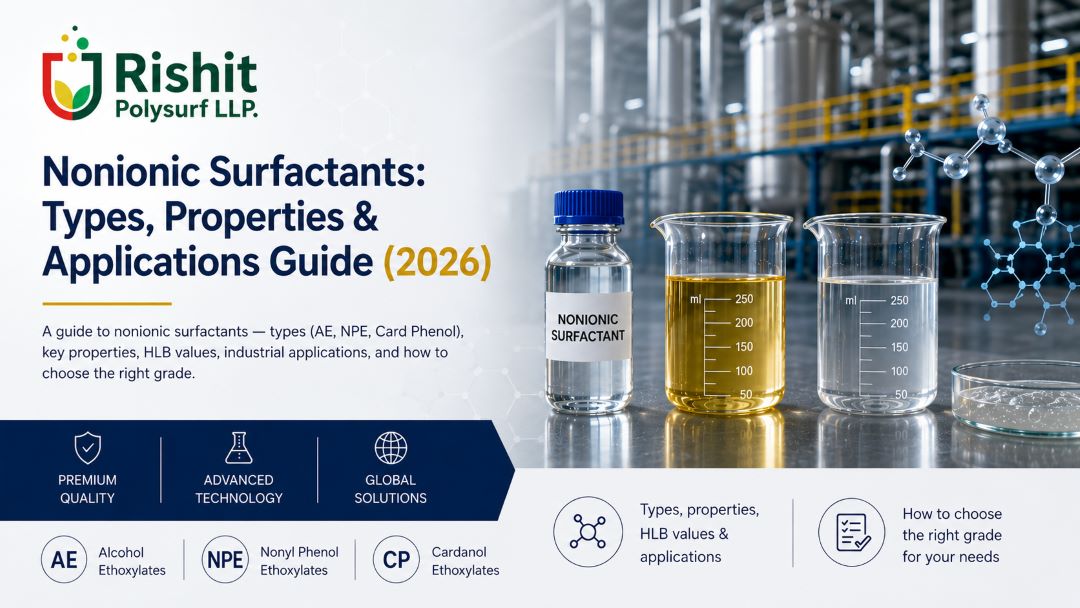
Within this family, three chemistries account for the majority of industrial-scale usage: Alcohol Ethoxylates (AE), valued for biodegradability and as SLES feedstock; Nonyl Phenol Ethoxylates (NPE), prized for low-cost, high-performance emulsification but increasingly constrained by regulation; and Card Phenol Ethoxylates (CPE), a bio-based, cashew-derived alternative gaining ground wherever formulators need NPE-level performance without the compliance risk.
What Are Nonionic Surfactants?
Nonionic surfactants are surface-active agents whose hydrophilic head carries no electrical charge. Where anionic surfactants rely on a negatively charged group (such as a sulfate or sulfonate) and cationic surfactants rely on a positively charged one, nonionic surfactants build their water affinity from neutral, polar functional groups — most often repeating units of ethylene oxide (EO), or other polyol structures such as sorbitan or glucose rings.
Every nonionic surfactant molecule shares the same two-part architecture:
- Hydrophobic tail — typically a long-chain fatty alcohol, alkylphenol, or fatty acid backbone. This portion associates with oils, greases, and non-polar surfaces.
- Hydrophilic head — a chain of ethylene oxide units (or another polyol structure) attached to the tail. This portion associates with water. Adding more EO units makes the molecule progressively more water-soluble.
Because the molecule carries no charge, it can lower the surface tension of water — typically from around 72 mN/m for pure water down to the 30–40 mN/m range — without the electrostatic attraction or repulsion effects that ionic surfactants generate. This is what allows a nonionic surfactant to spread rapidly across a solid or fabric surface and displace air, rather than beading up: the wetting mechanism that gives this class of chemistry its everyday name in formulation work.
How Do Nonionic Surfactants Work?
Nonionic surfactants derive their practical value from one behavior: they preferentially migrate to interfaces — the boundary between two immiscible phases, such as oil and water, or water and a solid surface — and orient themselves there, hydrophobic tail toward the oil or solid, hydrophilic head toward the water. That single behavior, repeated at enormous scale, produces five distinct formulation effects.
- Wetting. A droplet of water on an untreated surface beads up because of high surface tension. Nonionic surfactant molecules adsorb at the water–air and water–solid interfaces, lowering surface tension enough that the liquid spreads and penetrates instead of beading — critical in textile scouring, agrochemical spray coverage, and cleaning.
- Emulsification. When oil and water are mixed with a nonionic surfactant, the molecules coat newly formed oil droplets — tail in, head out — preventing them from recombining back into a separate oil layer. The result is a stable oil-in-water or water-in-oil emulsion.
- Solubilization. Above a threshold concentration — the critical micelle concentration (CMC) — surfactant molecules self-assemble into spherical clusters called micelles, hydrophobic tails pointing inward. These micelles trap small amounts of oil-soluble material inside their core, effectively dissolving substances that wouldn't normally mix with water.
- Detergency. Wetting, emulsification, and solubilization work together to lift soil, grease, and particulate matter off a surface and hold it suspended in the wash liquor rather than letting it redeposit — the basis of all detergent chemistry.
- Dispersion. Nonionic surfactants adsorb onto the surface of solid particles — pigments in a coating, clay in a drilling fluid — creating a hydrophilic coating that keeps particles from clumping together and settling out.
Types of Nonionic Surfactants
Alcohol Ethoxylates (AE)
Alcohol Ethoxylates (AE) are produced by reacting a fatty alcohol — commonly lauryl (C12), myristyl (C14), or a C12–C14 blend — with ethylene oxide under controlled temperature and pressure. The general structure is R-O-(CH₂CH₂O)ₙ-H, where R is the alkyl chain from the parent alcohol and n is the number of EO moles added.
Because the hydrophobic tail is a straight-chain fatty alcohol rather than an aromatic ring, AE grades typically show favorable, consistent biodegradability. Industrially, AE grades are used as primary surfactants in liquid detergents, wetting agents in textiles, and feedstock for sulfation into SLES.
Rishit Polysurf's Lauryl Alcohol Ethoxylate range spans grades from roughly HLB 8 to HLB 16.5.
Nonyl Phenol Ethoxylates (NPE)
Nonyl Phenol Ethoxylates (NPE) are produced by ethoxylating nonylphenol, an alkylphenol feedstock. The aromatic ring in the hydrophobic tail gives NPE grades excellent, low-cost emulsification and wetting performance, along with a low critical micelle concentration.
What is NPE and Why Does It Matter?
While newer, bio-based surfactants often capture industry headlines, Nonyl Phenol Ethoxylates (NPE) remain the undisputed workhorse of global industrial manufacturing. The reason is pure chemical economics: NPE delivers unmatched performance stability in extreme pH environments, high electrolyte concentrations, and hard water conditions where other standard surfactants completely fail.
From stabilizing complex acrylic polymerizations to ensuring agrochemical concentrates disperse flawlessly in the field, NPEs provide the essential bridge between oil and water. However, successfully formulating requires a precise understanding of HLB and cloud point dynamics. Selecting the wrong mole count—for example, specifying NP-4 when a system requires NP-9—will instantly result in phase separation or emulsion failure.
Chemistry & Synthesis: How NPE is Made
It is produced in a precise, two-stage process. First, nonyl phenol is charged into a high-pressure reactor. Ethylene oxide (EO) is then added mole-by-mole under alkali catalysis, converting the oil-soluble phenol into a highly tunable, water-compatible surfactant:
C9H19-C6H4-OH + n(C2H4O) → C9H19-C6H4-O-(C2H4O)n-H(CAS: 9016-45-9 | Nonyl Phenol reacting with n moles Ethylene Oxide)
Technical Grade Specifications
| Grade | EO Moles | HLB | Appearance (25 °C) | Cloud Point (°C) |
|---|---|---|---|---|
| NP-4.5 | 4.5 | 9.8 | Clear Liquid | 58–63 |
| NP-6 | 6 | 10.9 | Clear Liquid | 65–70 |
| NP-9 | 9 | 12.8 | Clear Liquid | 52–56 |
| NP-10 | 10 | 13.3 | Clear Liquid | 65–68 |
| NP-20 | 20 | 16.0 | Waxy solid | 73–76 |
Card Phenol Ethoxylates (CPE)
Card Phenol Ethoxylates (CPE), also called Cardanol Ethoxylates, are produced by ethoxylating cardanol — a phenolic compound extracted from Cashew Nut Shell Liquid (CNSL), a renewable by-product of cashew processing. Chemically, CPE behaves much like NPE, since both start from an aromatic, phenolic hydrophobe.
Because CPE isn't derived from petroleum-based alkylphenols, it is increasingly positioned as a clean-label, drop-in replacement for NPE in formulations built for green-chemistry, eco-label, or ZDHC MRSL-aligned supply chains. Explore the full Card Phenol Ethoxylate range.
Other Nonionic Surfactant Types
- Fatty Alcohol Ethoxylates: A broader category made from C12–C18 fatty alcohols used in industrial lubricants.
- Sorbitan Esters: Nonionic emulsifiers made by esterifying sorbitol with fatty acids.
- Alkyl Polyglucosides (APG): Surfactants built from natural sugars and fatty alcohols, prized for very high biodegradability.
- PEG Esters: Fatty acid esters of polyethylene glycol, used as emulsifiers and viscosity modifiers.
Key Properties & Advantages
| Property | Benefit |
|---|---|
| Excellent Wetting | Rapidly lowers surface tension for fast, even penetration into fabrics, soils, and porous substrates. |
| Hard Water Stability | No electrical charge means no reaction with Ca²⁺/Mg²⁺ ions — consistent performance regardless of water hardness. |
| Electrolyte Tolerance | Remains active and stable in high-salt, high-alkali, and acidic formulations. |
| Thermal Stability | Maintains surface activity across a defined processing-temperature window, up to the grade's cloud point. |
Limitations of Nonionic Surfactants
- Temperature sensitivity & Cloud point: Nonionic surfactants stay dissolved through hydrogen bonding. Heat the solution past a certain point (the cloud point) and the surfactant dehydrates and separates out.
- Regulatory restrictions: Nonylphenol and its ethoxylates are restricted under REACH Annex XVII in the EU across most major industrial use categories. Export-facing textile supply chains also restrict NPE voluntarily (e.g., ZDHC MRSL).
Industrial Applications
Textile Processing
Core wetting agents driving scouring, wetting, and dyeing. Grade selection targets a cloud point that assists soil release during the hot stages of the cycle.
Industrial Cleaning
Emulsifies mineral oils and greases. Mid-HLB grades blend with caustic builders for heavy-duty metalworking and parts-washing applications.
Agrochemicals
Low-to-mid HLB grades act as emulsifiers in Emulsifiable Concentrates (EC); higher-HLB grades act as spray adjuvants improving rain-fastness.
Paints, Paper & Oilfield
Functions as pigment dispersants in paints, deinking agents in paper, and provides high-salinity emulsion control in oil & gas drilling fluids.
Understanding HLB & Selection
HLB (Hydrophilic-Lipophilic Balance) is a numerical scale (roughly 0 to 20) describing how water-loving or oil-loving a surfactant is. By Griffin's method:
| HLB Range | Character | Common Applications |
|---|---|---|
| 2–6 | Strongly lipophilic | Defoamers, W/O emulsifiers |
| 6–9 | Lipophilic | W/O emulsifiers, EC co-emulsifiers |
| 9–13 | Balanced / wetting | Wetting agents, general-purpose emulsifiers |
| 13–16 | Hydrophilic | O/W emulsifiers, detergents, cleaning |
| 16–20 | Strongly hydrophilic | Solubilizers, hydrophilic stabilizers |
Conclusion
There's no single "best" nonionic surfactant—only the grade that best matches your formulation, operating conditions, and desired performance. Getting the choice right comes down to defining the application, setting your foam and temperature limits, matching the HLB, and validating compatibility on the bench before you scale.
Request TDS, MSDS, Samples or Bulk Pricing
Rishit Polysurf LLP manufactures Lauryl Alcohol Ethoxylates, Nonyl Phenol Ethoxylates, and Card Phenol Ethoxylates from our facility in GIDC Dholka, Gujarat. Contact our technical sales team for grade selection, sample availability, and bulk pricing.
Related Products
Lauryl Alcohol Ethoxylates
Rishit Polysurf manufactures Lauryl Alcohol Ethoxylates in India, including LA-1 to LA-30 grades for detergents, SLES, textile, agrochemical and industrial cleaning formulations. Request TDS, MSDS, samples and bulk pricing.
Nonyl Phenol Ethoxylates
Rishit Polysurf manufactures Nonyl Phenol Ethoxylates in India, including NP-4 to NP-40 grades for detergents, textiles, agrochemicals, cleaning and industrial formulations. Request TDS, MSDS, samples and bulk pricing.
Card Phenol Ethoxylates
Card Phenol Ethoxylate / Cardanol Ethoxylate manufacturer in India. Rishit Polysurf supplies CP series grades for agrochemical, textile, cleaning and industrial formulations. Request TDS, MSDS, samples and bulk pricing.
Polysorbate 80
Polysorbate 80 (Tween 80) manufacturer in India — COA, MSDS, and technical support for pharma, cosmetic, food, and industrial buyers. Request bulk pricing.
Polysorbate 20
Industrial-grade Polysorbate 20 manufacturer offering consistent quality, technical support, COA, MSDS, and bulk supply for global industries.
Frequently Asked Questions
Nonionic surfactants are surface-active agents whose hydrophilic head carries no electrical charge. They lower surface tension and interfacial tension between oil and water using neutral, polar groups — typically ethylene oxide chains — rather than an ionic group, which makes them stable in hard water and compatible with other surfactant types.
The most widely used industrial nonionic surfactants are Alcohol Ethoxylates (AE), Nonyl Phenol Ethoxylates (NPE), and Card Phenol Ethoxylates (CPE). Other examples include broader fatty alcohol ethoxylates, sorbitan esters, alkyl polyglucosides, and PEG esters.
They migrate to the interface between two phases — such as oil and water — and orient with their hydrophobic tail toward the oil and hydrophilic head toward the water. This lowers interfacial tension and enables wetting, emulsification, solubilization, detergency, and dispersion.
Nonionic surfactants are used across detergents and industrial cleaning, textile wet processing, agrochemical formulations, paints and coatings, paper processing, and oil and gas operations.
Generally, yes. Because their hydrophobic tail is a straight-chain fatty alcohol, most Alcohol Ethoxylate grades show favorable primary and ultimate biodegradability compared with alkylphenol-based nonionics, though exact results depend on the specific grade and test method.
Yes. In the EU, nonylphenol and its ethoxylates are restricted under REACH Annex XVII across most major industrial use categories, and residues in finished textile articles are capped separately. In the US, they're subject to EPA reporting and review requirements under TSCA. Many export-facing supply chains also restrict NPE voluntarily, through frameworks like the ZDHC MRSL.
HLB (Hydrophilic-Lipophilic Balance) is a roughly 0–20 scale describing how water-loving or oil-loving a surfactant is. Low-HLB grades suit oil-continuous systems; high-HLB grades suit water-continuous systems, detergency, and solubilization.
Mid-to-high HLB Alcohol Ethoxylate or Nonyl Phenol Ethoxylate grades (roughly HLB 12–14) are the most common actives in liquid detergents, dishwashing liquids, and all-purpose cleaners, typically co-formulated with anionic surfactants like LAS or SLES.
Work through application, foam tolerance, operating temperature, required HLB, EO mole count, solubility and cloud point at use concentration, and compatibility with the rest of the formulation — then confirm the choice with bench-scale testing.
Yes. Because they carry no charge, nonionic surfactants blend freely with anionic, cationic, and amphoteric surfactants without precipitation or charge neutralization, which is why they're routinely used as co-surfactants in multi-component systems.
Both use an aromatic, phenolic hydrophobe and deliver similar emulsification and wetting performance. NPE is synthesized from petroleum-derived nonylphenol and faces regulatory restrictions in several markets. CPE is synthesized from cardanol, a renewable by-product of cashew processing, and is positioned as a bio-based alternative with comparable performance and a lighter regulatory footprint.
Yes. Rishit Polysurf LLP's technical sales team supports HLB matching, grade recommendations, and TDS, MSDS, and sample requests across its Alcohol Ethoxylate, Nonyl Phenol Ethoxylate, and Card Phenol Ethoxylate ranges, manufactured at its facility in GIDC Dholka, Gujarat.