HLB Value Explained: How to Choose the Right Surfactant for Industrial Applications
Formulating industrial chemicals is rarely a matter of simple mixing. Whether you are engineering a stable agricultural emulsion, a heavy-duty metal degreaser, or a high-performance textile scouring agent, the stability and efficacy of your formulation depend entirely on surface chemistry. At the core of this chemistry is the selection of the correct surfactant.
For industrial formulators, chemical manufacturers, and R&D professionals, navigating the vast array of available surfactants can be a complex challenge. Among the many parameters used to classify these chemicals, one metric stands above the rest as the definitive starting point: the HLB Value.
Understanding the Hydrophilic-Lipophilic Balance (HLB) is critical for predicting how a surfactant will behave in a specific system. This guide will break down the mechanics of the HLB scale, detail how it influences surfactant performance, and provide a comprehensive framework for selecting the right nonionic surfactants for your industrial applications. For a broader overview of these chemicals before diving into the mathematics of selection, you can refer to our comprehensive guide to nonionic surfactants.
What is HLB Value?
HLB stands for Hydrophilic-Lipophilic Balance. It is an empirical scale used to describe the proportional relationship between the water-loving (hydrophilic) and oil-loving (lipophilic) portions of a surfactant molecule.
Surfactants (surface-active agents) are amphiphilic molecules. They possess a lipophilic non-polar "tail" that is attracted to oils, fats, and non-polar solvents, and a hydrophilic polar "head" that is attracted to water. The HLB value quantifies this dual nature, providing formulators with a standardized numerical value that predicts solubility and functional properties.
The History of the HLB System
The concept was first introduced in 1949 by William C. Griffin, a physical chemist working for the Atlas Powder Company, and was further refined in 1954. Prior to Griffin's system, formulators relied heavily on trial and error, testing hundreds of surfactant combinations to stabilize a single emulsion.
Griffin recognized that nonionic surfactants could be mathematically classified based on their molecular weight fractions. For nonionic surfactants—such as ethoxylates—Griffin established the following formula:
This calculation yields a value on a scale from 0 to 20.
Why Formulators Rely on HLB
The HLB value is the formulator's compass. It eliminates the guesswork in the initial stages of product development. By knowing the Required HLB (RHLB) of the oil phase in a formulation, an R&D chemist can immediately narrow down the surfactant search from hundreds of candidates to a targeted few, saving significant time, raw material costs, and laboratory resources.
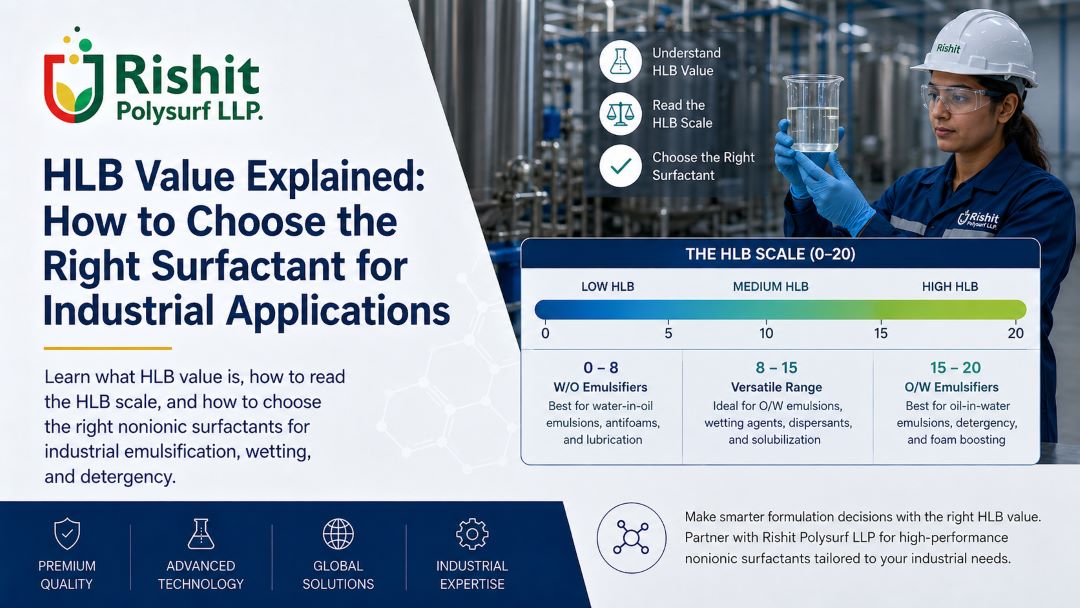
Understanding the HLB Scale
The Griffin HLB scale typically ranges from 0 to 20 for nonionic surfactants. The scale operates on a simple premise:
- A lower HLB value indicates a more lipophilic (oil-soluble) surfactant.
- A higher HLB value indicates a more hydrophilic (water-soluble) surfactant.
| HLB Range | Characteristics | Typical Applications |
|---|---|---|
| 1 – 3 | Highly lipophilic, completely insoluble in water. | Anti-foaming agents, defoamers in industrial processes. |
| 3 – 6 | Lipophilic, poor water solubility. | Water-in-Oil (W/O) emulsifiers. |
| 7 – 9 | Marginally water-soluble, good dispersion. | Wetting agents, penetrating agents for textiles and agriculture. |
| 8 – 16 | Water-soluble, highly versatile. | Oil-in-Water (O/W) emulsifiers, detergents. |
| 13 – 15 | High water solubility, excellent cleansing properties. | Heavy-duty detergents, industrial cleaners, degreasers. |
| 15 – 18 | Highly hydrophilic. | Solubilizers for essential oils, fragrances, and active ingredients. |
How HLB Influences Surfactant Performance
The functional application of an industrial surfactant is entirely dictated by its positioning on the HLB scale. Here is a technical breakdown of how HLB dictates specific performance metrics.
- Wetting (HLB 7–9): Wetting is the process of displacing air from a solid surface and replacing it with a liquid. Surfactants with an HLB of 7 to 9 have the optimal molecular geometry to rapidly migrate to the solid-liquid interface. Example: In agricultural formulations, wetting agents ensure that pesticidal sprays spread evenly across hydrophobic plant leaves.
- Detergency (HLB 13–15): Surfactants in the 13–15 HLB range exhibit high water solubility and easily form spherical micelles in water. These micelles encapsulate oil and grease particles, stripping them from the substrate. Example: Industrial floor cleaners and commercial laundry detergents.
- Emulsification (HLB 3–6 and 8–16): The surfactant localizes at the oil-water interface, reducing interfacial tension. The choice of HLB directly dictates which phase will become the droplet and which will become the continuous medium.
- Foaming (HLB > 12): While nonionics are generally lower-foaming, those with higher HLB values can generate moderate to high foam. Example: Textile foam finishing or manual dishwashing liquids.
- Solubilization (HLB 15–18): The process of making highly insoluble substances appear completely dissolved in water. Example: Incorporating lipophilic fragrances into clear aqueous room fresheners.
Oil-in-Water vs Water-in-Oil Emulsions
The relationship between HLB and emulsion phase dynamics is governed by Bancroft's Rule, which states: The phase in which an emulsifier is more soluble constitutes the continuous phase.
- Oil-in-Water (O/W) Emulsions (HLB 8–16): Oil droplets are dispersed throughout a continuous water phase. They are water-washable and conduct electricity.
- Water-in-Oil (W/O) Emulsions (HLB 3–6): Water droplets are dispersed throughout a continuous oil phase. They are heavier, greasy, and repel ambient moisture.
Industrial Cleaners (O/W)
Heavy machinery degreasers use O/W emulsions to lift industrial oils into an aqueous wash stream that can be rinsed away with water.
Paints & Coatings (O/W)
Waterborne alkyd paints rely on O/W emulsifiers to suspend oil-based binder resins in a low-VOC, water-continuous phase.
Agrochemicals (W/O & O/W)
Emulsifiable Concentrates (ECs) bloom into an O/W emulsion in a spray tank, while invert emulsions use W/O to resist rain wash-off.
Lubricants (O/W)
Soluble cutting oils use water for rapid cooling, while suspended oil droplets provide lubrication at the tool-metal interface.
How to Choose the Right Surfactant Using HLB
- Step 1: Identify the Application. Determine if you need to wet a surface, solubilize an active, or create an emulsion.
- Step 2: Determine the Required HLB (RHLB). Every oil has a required HLB. Formulators often blend high-HLB and low-HLB surfactants to achieve the exact RHLB. For instance, achieving an exact HLB requires understanding the difference between grades like NP-9 and NP-10.
- Step 3: Account for Temperature and Cloud Point. Nonionic surfactants become insoluble when heated past their Cloud Point. For detergency, select an ethoxylate with a Cloud Point slightly above your operating temperature.
- Step 4: Evaluate Electrolytes. High salt concentrations depress the Cloud Point, effectively making the surfactant behave as if it has a lower HLB.
- Step 5: Check Compatibility. HLB alone should never be the only selection criterion. Molecular geometry and carbon chain length play equally important roles.
HLB Values of Common Nonionic Surfactants
| Surfactant Class | HLB Range | Water Solubility | Applications & Advantages |
|---|---|---|---|
| Lauryl Alcohol Ethoxylates (LAE) | 5.0 – 16.0 | Dispersible to highly soluble | Personal care, industrial cleaners, textile scouring. Excellent biodegradability. |
| Nonyl Phenol Ethoxylates (NPE) | 4.0 – 18.0 | Dispersible (NP-4) to highly soluble (NP-10+) | Agrochemicals, degreasing, paper manufacturing. Highly cost-effective and robust. |
| Card Phenol Ethoxylates (CPE) | 8.0 – 15.0 | Water-soluble at higher EO | Leather processing, bio-based cleaning. Derived from renewable cashew nutshell liquid. |
| Ethoxylated Castor Oil | 10.0 – 15.0 | Dispersible to soluble | Agrochemicals, cutting oils. Superior lubricity. |
| Alcohol Alkoxylates (EO/PO) | 3.0 – 12.0 | Poor to moderate | Auto dishwashing, CIP cleaners. Low foaming characteristics. |
Industrial Applications of HLB-Based Surfactant Selection
- Textiles: Formulators utilize LAE or NPE grades with an HLB of 9–13 for scouring, ensuring rapid penetration of aqueous dyes.
- Industrial Cleaning (I&I): Removing heavy hydrocarbons requires robust detergency, relying on surfactants in the HLB 12–15 range.
- Agrochemicals: Emulsifiable Concentrates utilize blends possessing an HLB of 11–13 to force a spontaneous, thermodynamically stable O/W emulsion in the spray tank.
- Leather Industry: Card Phenol Ethoxylates are extensively utilized in the soaking and degreasing stages to remove natural animal fats, requiring an HLB of 12-14.
Common Mistakes When Selecting Surfactants
- Choosing Only by HLB: Two surfactants with an HLB of 12 perform entirely differently due to distinct hydrophobic tail structures (e.g., linear vs. aromatic).
- Ignoring the Cloud Point: Selecting a surfactant without matching its thermal stability to the operating temperature will result in failure. Read our guide on selecting the right Lauryl Alcohol Ethoxylate grade to understand these dynamics.
- Using a Single Surfactant: Stabilizing a complex emulsion with one surfactant rarely works long-term. Blends of high-HLB and low-HLB surfactants form tighter interfacial barriers.
Conclusion
The Hydrophilic-Lipophilic Balance (HLB) is far more than an arbitrary number; it is the fundamental language of surface chemistry. By understanding the HLB scale, formulators can strategically dictate how a surfactant behaves at the interface of oil, water, and solid substrates. However, theoretical calculations are only the beginning. Achieving commercial viability requires accounting for Cloud Points, specific oil phase requirements, and the unique environmental stresses of industrial applications. Experienced technical guidance is often the difference between a failing emulsion and a market-leading product.
Request TDS, MSDS, Samples or Bulk Pricing
Rishit Polysurf LLP manufactures Lauryl Alcohol Ethoxylates, Nonyl Phenol Ethoxylates, and Card Phenol Ethoxylates from our facility in GIDC Dholka, Gujarat. Contact our technical sales team for grade selection, sample availability, and bulk pricing.
Related Products
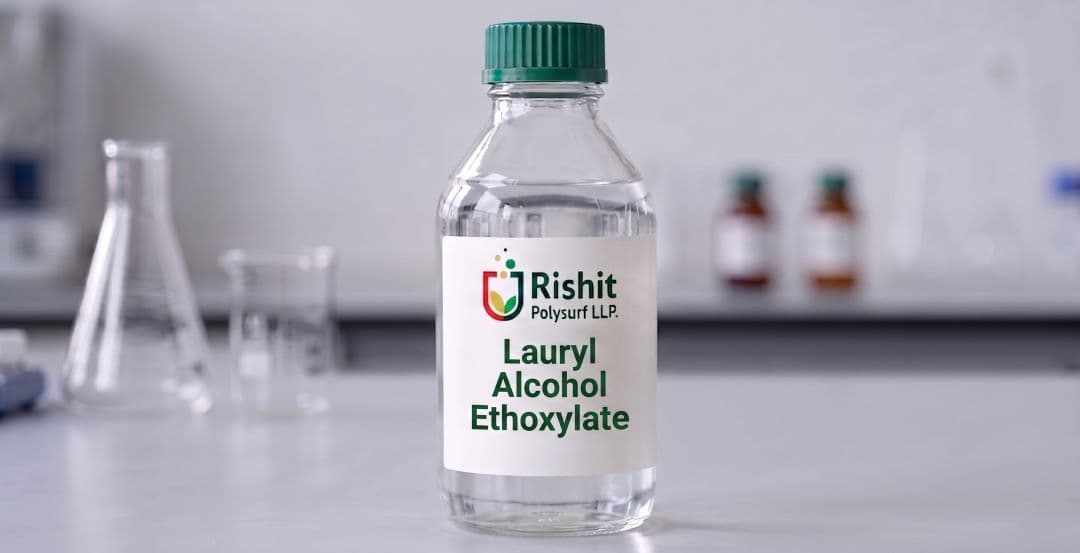
Lauryl Alcohol Ethoxylates
Rishit Polysurf manufactures Lauryl Alcohol Ethoxylates in India, including LA-1 to LA-30 grades for detergents, SLES, textile, agrochemical and industrial cleaning formulations. Request TDS, MSDS, samples and bulk pricing.
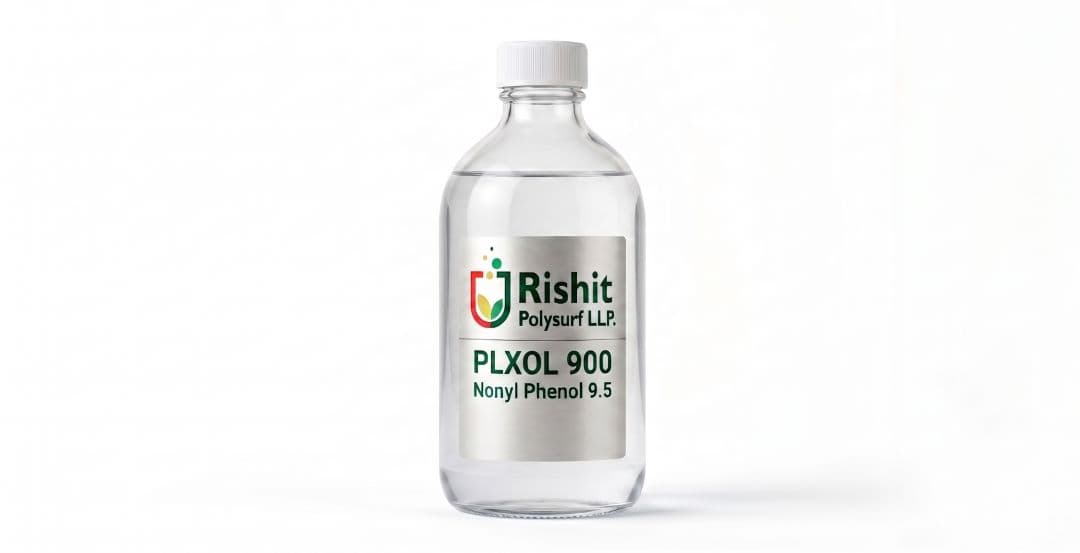
Nonyl Phenol Ethoxylates
Rishit Polysurf manufactures Nonyl Phenol Ethoxylates in India, including NP-4 to NP-40 grades for detergents, textiles, agrochemicals, cleaning and industrial formulations. Request TDS, MSDS, samples and bulk pricing.
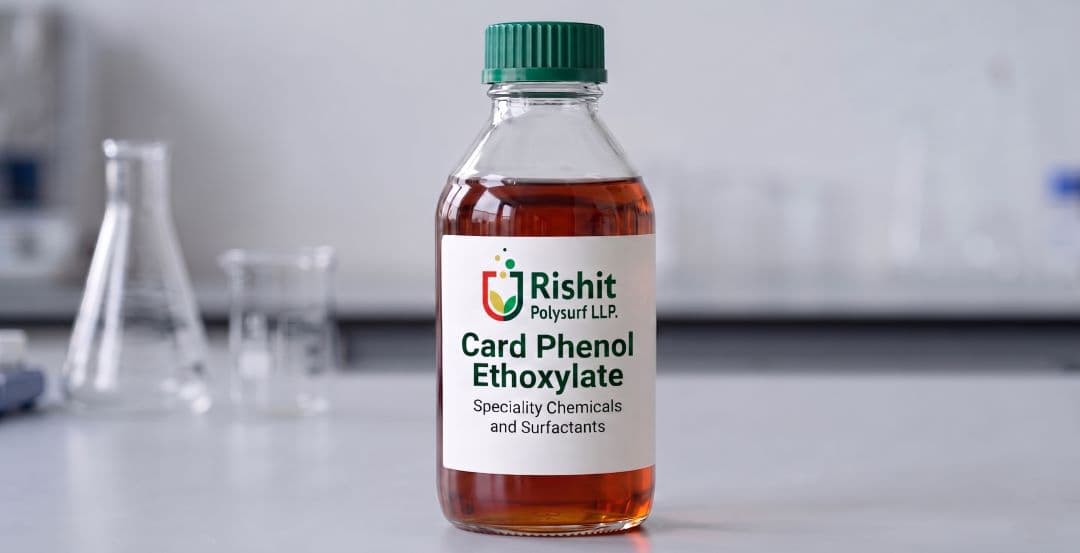
Card Phenol Ethoxylates
Card Phenol Ethoxylate / Cardanol Ethoxylate manufacturer in India. Rishit Polysurf supplies CP series grades for agrochemical, textile, cleaning and industrial formulations. Request TDS, MSDS, samples and bulk pricing.
Polysorbate 80
Polysorbate 80 (Tween 80) manufacturer in India — COA, MSDS, and technical support for pharma, cosmetic, food, and industrial buyers. Request bulk pricing.
Polysorbate 20
Industrial-grade Polysorbate 20 manufacturer offering consistent quality, technical support, COA, MSDS, and bulk supply for global industries.
Frequently Asked Questions
HLB stands for Hydrophilic-Lipophilic Balance. It is a numerical scale indicating the ratio of water-loving to oil-loving portions of a surfactant molecule.
There is no single 'good' HLB value. The ideal value depends entirely on the application: HLB 4 is excellent for water-in-oil emulsions, while HLB 14 is excellent for heavy-duty cleaning.
A high HLB (typically 11-18) means the surfactant is highly hydrophilic (water-soluble). It will easily dissolve in water and is generally used for O/W emulsions, detergency, and solubilization.
Yes, HLB is the primary predictor of a surfactant's general functionality (wetting, emulsifying, cleaning). However, it does not account for specific interactions caused by the molecular structure of the hydrophobic tail.
For nonionic surfactants, it is calculated using Griffin's formula, which divides the molecular weight of the hydrophilic portion by the total molecular weight of the molecule, multiplied by 20.
HLB eliminates the trial-and-error process in product formulation. It allows chemists to rapidly identify the specific category of surfactant required to stabilize their emulsion or achieve their cleaning targets.
Highly ethoxylated nonionic surfactants, such as Nonyl Phenol Ethoxylates with 10 to 40 moles of Ethylene Oxide (e.g., NP-10 to NP-40) or highly ethoxylated Lauryl Alcohols, have high HLB values.
No. Optimal cleaning occurs when the surfactant's HLB matches the specific nature of the soil being removed and the operating temperature of the wash bath (just below the surfactant's Cloud Point).
Surfactants or surfactant blends with an HLB value between 8 and 16 are typically required to form stable Oil-in-Water (O/W) emulsions.
Formulators must consider the Cloud Point, molecular geometry (linear vs branched tails), electrolyte concentration, system pH, operating temperature, and potential synergistic effects with other formulation ingredients.