Polysorbate 20 Uses, Properties & Applications
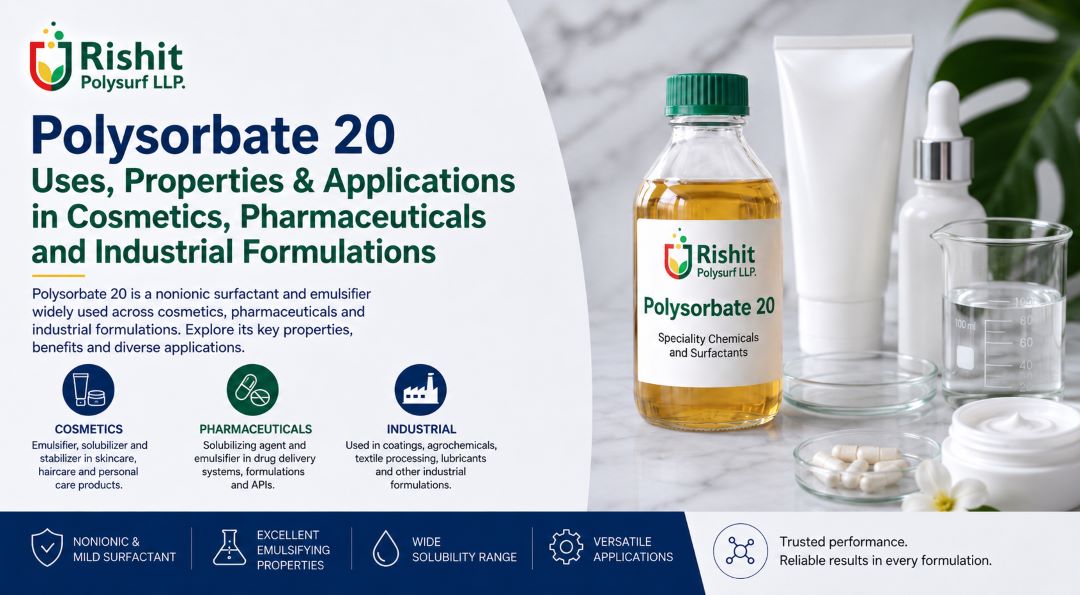
Polysorbate 20 Uses, Properties & Applications in Cosmetics, Pharmaceuticals and Industrial Formulations
What Is Polysorbate 20?
Polysorbate 20 is a nonionic surfactant produced by esterifying sorbitan, a cyclic derivative of sorbitol, with lauric acid, then reacting the resulting ester with ethylene oxide. This ethoxylation step attaches polyoxyethylene chains to the sorbitan-ester backbone, giving the molecule its scientific name, polyoxyethylene (20) sorbitan monolaurate. It belongs to the broader polysorbate family, surfactants built on the same sorbitan-ester framework but varying in fatty acid, which is why a related material such as Polysorbate 80 shares structural similarities while performing somewhat differently in formulation.
The defining feature of this ingredient is its nonionic character. Unlike anionic or cationic surfactants, a nonionic surfactant carries no net electrical charge in water, which makes it less reactive with oppositely charged ingredients, more tolerant of pH variation, and less sensitive to ionic strength than charged surfactants. These characteristics, covered further in our guide to nonionic surfactants, are why this class of surfactant is such a common starting point when formulators need a versatile, broadly compatible emulsifying or solubilizing agent.
Structurally, the molecule has two distinct regions: a hydrophilic "head" formed by the polyoxyethylene sorbitan portion, and a lipophilic "tail" from the lauric acid chain. This dual affinity lets the molecule position itself at the boundary between water and oil-based materials, which is the basis for its role as an emulsifier, solubilizer, wetting agent, and dispersing aid across cosmetic, pharmaceutical, and industrial formulation systems.
Key Properties of Polysorbate 20
Several properties explain why formulators reach for this ingredient across such a wide range of product types:
- Nonionic nature – No net electrical charge in solution; generally compatible with anionic, cationic, and amphoteric ingredients, though this should be confirmed per formulation.
- Emulsification – Migrates to the oil-water interface, lowering interfacial tension to help form and stabilize oil-in-water emulsions.
- Solubilization – Above a threshold concentration, molecules assemble into micelles that can hold small amounts of oil-soluble material within an aqueous system.
- Wetting – Reduces surface tension, helping aqueous formulations spread evenly across a surface.
- Dispersion – Keeps fine particulates or droplets evenly distributed rather than settling or clumping.
- Water compatibility – Disperses readily in water, suiting predominantly aqueous systems.
- HLB characteristics – Generally recognized in industry literature as having a comparatively high hydrophile-lipophile balance, often cited in the region of 16 to 17, consistent with its typical use in oil-in-water emulsification and solubilization rather than water-in-oil systems. Exact HLB varies by grade and manufacturing process, so current values should be confirmed against the relevant technical data sheet.
- Formulation compatibility – Generally compatible with a wide range of other surfactants, emollients, and functional ingredients, though bench-scale testing is recommended for any new formulation.
- Physical characteristics – Typically a viscous liquid ranging from colorless to pale yellow, with a mild odor; exact parameters for a specific grade should be confirmed against the current TDS.
Polysorbate 20 Uses and Applications
This surfactant's combination of emulsifying, solubilizing, wetting, and dispersing properties allows it to serve slightly different purposes depending on the formulation category. The sections below outline how it is typically used across cosmetic, pharmaceutical, and industrial systems, and why formulators reach for it in each context.
Polysorbate 20 in Cosmetics and Personal Care
In cosmetic and personal care formulations, this ingredient is valued for the combination of functions it performs within a single system, rather than any one property alone.
In skincare formulations, it is frequently used to solubilize oil-soluble actives, botanical extracts, or fragrance components into water-based serums and toners, helping these products stay visually clear rather than separating into layers. In creams and lotions, it contributes to forming and maintaining oil-in-water emulsions, keeping the oil phase — emollients, oils, or butters — evenly dispersed throughout the water phase during manufacturing and storage.
In cleansers, its mild, nonionic character lets it work alongside primary cleansing surfactants, helping solubilize oils and disperse residues without the added ionic strength of some anionic systems. In shampoos and other rinse-off products, it plays a similar solubilizing role, helping incorporate fragrance oils, conditioning agents, or silicones evenly into the surfactant base.
Fragrance-containing and essential-oil-containing formulations rely on this functionality particularly heavily, since most fragrance and essential oil components are hydrophobic and would otherwise separate from an aqueous base. Solubilizing these components at the micellar level helps formulators achieve stable, often visually clear, finished products.
Polysorbate 20 in Pharmaceutical Formulations
In pharmaceutical formulation contexts, this nonionic surfactant is used primarily for its solubilization, emulsification, and stabilization functions rather than for any therapeutic effect of its own.
Solubilization is one of its most established roles: many active ingredients and excipients have limited water solubility, and a nonionic surfactant can help incorporate them into aqueous formulations by forming micellar structures that keep the material dispersed at a very fine scale. Emulsification is relevant in emulsion-based formulations, helping form and maintain a stable dispersion between aqueous and non-aqueous phases. Stabilization is a further consideration in some systems, where nonionic surfactants help protect sensitive components from physical or interfacial stresses during processing, storage, or handling.
Suitability for any specific pharmaceutical application depends on factors beyond the general properties described here, including the grade used, concentration, the requirements of the dosage form, applicable pharmacopeial standards, and the regulatory requirements of the market the finished product will be sold into. Formulators should confirm that a given grade meets the compendial and regulatory requirements relevant to their intended use, rather than assuming a general-purpose or cosmetic-grade material is automatically suitable for pharmaceutical applications.
Polysorbate 20 in Industrial Formulations
Beyond cosmetics and pharmaceuticals, this surfactant is also used in specialty and industrial formulation systems where its nonionic, emulsifying, and wetting characteristics are useful.
Emulsification and solubilization are relevant wherever a formulation needs to combine water-based and oil-based or hydrophobic components into a stable, homogeneous system, whether a specialty liquid, a process aid, or a concentrate intended for dilution. Wetting behavior helps where improved surface contact between an aqueous solution and a solid or oily surface is required, and dispersion properties keep fine particulates or droplets evenly distributed rather than settling out.
In cleaning and related formulation applications, nonionic surfactants of this type are sometimes incorporated where a mild, broadly compatible surfactant is needed alongside other components, though the appropriate surfactant system always depends on the specific soils, surfaces, and performance requirements of the finished product. Because industrial requirements vary considerably by application, buyers and formulators should evaluate this ingredient's performance directly within their own formulation and process conditions rather than assuming performance from general information alone.
How Polysorbate 20 Works as an Emulsifier and Solubilizer
Emulsification and solubilization are often mentioned together, but they describe two distinct mechanisms, and understanding the difference is useful when deciding how to use this ingredient in a formulation.
Emulsification refers to dispersing one liquid as fine droplets within another it would not normally mix with, most often oil droplets within a continuous water phase. Left alone, oil and water separate because of high interfacial tension. A surfactant molecule, with its hydrophilic head oriented toward water and its lipophilic tail toward oil, positions itself at this interface and lowers that tension, allowing mixing or homogenization to break the oil phase into small droplets. The surfactant film around each droplet then resists the droplets recombining, or coalescing, over time — the basic mechanism behind forming and stabilizing oil-in-water emulsions such as many creams, lotions, and industrial emulsion systems.
Solubilization works differently and generally applies to much smaller quantities of hydrophobic material than emulsification. Above a certain concentration, known as the critical micelle concentration, surfactant molecules in water assemble into micelles — small clusters with lipophilic tails oriented inward, forming a hydrophobic core, and hydrophilic heads facing outward toward the surrounding water. This core can hold small amounts of oil-soluble material at a near-molecular level rather than as visible droplets, which is why solubilized formulations — such as a fragrance-containing toner — can often remain visually clear despite containing hydrophobic components.
In practice, a single formulation may rely on both mechanisms at once, using the surfactant to stabilize a primary emulsion while also solubilizing smaller amounts of additional oil-soluble ingredients within the same system.
Factors Affecting Polysorbate 20 Performance in Formulations
Because this surfactant never functions in isolation, its real-world performance depends on the formulation and process conditions surrounding it. Relevant factors include:
- Concentration – Under- or over-dosing can affect performance, feel, and cost.
- Formulation composition – Other raw materials can interact with the surfactant and affect overall stability.
- Oil phase – The type and proportion of oil present affects how much surfactant is needed.
- Active ingredients – Some actives require specific solubilization approaches or may interact with the surfactant.
- Fragrance components – Fragrance load and composition influence the surfactant level required.
- Other surfactants – Often blended with other surfactants or emulsifiers to reach a target performance profile or HLB.
- pH – Nonionic surfactants are generally more pH-tolerant than ionic ones, though extreme pH can still affect stability.
- Temperature – Processing and storage temperatures influence solubility, viscosity, and emulsion stability.
- Compatibility – Should be confirmed through bench trials rather than assumed.
- Required HLB – Many oil phases require blending this surfactant with other emulsifiers to reach a specific target HLB.
- Stability – Confirmed through testing such as accelerated aging or freeze-thaw cycling.
General information like this is a useful starting point, but actual performance should always be validated within the specific finished formulation, using the real raw materials, process, and storage conditions involved.
Polysorbate 20 vs Polysorbate 80
Polysorbate 20 and Polysorbate 80 are both nonionic surfactants built on the same sorbitan-ester framework, and formulators frequently weigh them against each other when selecting an emulsifying or solubilizing agent. The key structural difference is the fatty acid used: this material is derived from lauric acid, a shorter, saturated fatty acid, while Polysorbate 80 comes from oleic acid, a longer, unsaturated one. That difference affects how each performs in a given system, including typical HLB, use levels, and which oil phases or actives each is better suited to solubilize or emulsify.
Because the two are not interchangeable in every formulation, the choice between them should reflect the specific requirements of the system being developed. For a detailed comparison of their properties, applications, and selection considerations, see our dedicated guide, Polysorbate 20 vs Polysorbate 80: Key Differences, Properties, Applications & Selection Guide.
How to Select Polysorbate 20 for a Formulation
Selecting the right material, and the right supplier, both matter when incorporating this surfactant into a formulation. Formulators and procurement teams evaluating options should consider:
- Intended application – Cosmetic, pharmaceutical, or industrial use affects which grade and documentation are needed.
- Required grade – Cosmetic-, pharmaceutical-, and industrial-grade materials differ in purity, documentation, and applicable standards.
- Formulation compatibility – Confirm through bench trials rather than assuming.
- Required specifications – Check appearance, HLB, moisture, acid value, and hydroxyl value against the current technical data sheet.
- Concentration – Typical use levels vary by application; confirm through formulation trials.
- Quality consistency – Supports predictable performance and reduces rework.
- Batch-to-batch consistency – Especially important at scale or under regulatory oversight.
- Technical data sheet (TDS) – Review for all relevant specifications before purchase.
- Safety data sheet (SDS/MSDS) – Review handling, storage, and safety information.
- Certificate of analysis (COA) – A batch-specific COA supports quality assurance and traceability.
- Samples – Request for bench-scale evaluation before committing to a bulk order.
- Bulk availability – Confirm production capacity and lead times.
- Supplier reliability – Consistency, responsiveness, and technical support matter as much as the material itself.
- Regulatory requirements – Confirm the grade and documentation meet the requirements applicable to your market and product category.
Teams ready to move from research to active evaluation can find current documentation, sample requests, and bulk order information on the Polysorbate 20 product page.
Quality and Specification Considerations
Ongoing quality evaluation matters for any buyer sourcing this ingredient on a recurring basis. Relevant considerations include:
- Product appearance – A visual check against the expected appearance for the grade is a quick initial indicator, not a substitute for formal specification testing.
- Relevant chemical and physical specifications – Verify parameters such as HLB, moisture, acid value, hydroxyl value, or saponification value against the current TDS and COA.
- Consistency – Reliable formulation performance depends on the raw material behaving the same way from batch to batch.
- Documentation – Complete, current TDS, SDS, and COA documentation supports internal quality processes and, where relevant, regulatory submissions.
- Quality control – Understand what quality control measures a supplier applies before releasing a batch for sale.
- Packaging – Appropriate packaging protects the material from contamination and degradation during transport and storage.
- Storage requirements – Following the storage conditions specified on the SDS and TDS helps preserve product quality until use.
- Technical support – Access to knowledgeable technical support helps formulators troubleshoot compatibility or performance questions.
Exact specifications vary by grade and manufacturing batch. Buyers who need precise values for a formulation or regulatory submission should refer to the current TDS, SDS, and COA for the specific product and lot, rather than general figures published in industry literature.
Conclusion
Polysorbate 20 is a nonionic surfactant used primarily for its ability to emulsify, solubilize, wet, and disperse across cosmetic, pharmaceutical, and industrial formulations. Its nonionic character, comparatively high HLB, and broad ingredient compatibility make it a common choice wherever water-based and oil-based or hydrophobic components need to come together into one stable, usable system.
Across cosmetics, it commonly supports skincare, cream, lotion, cleanser, and shampoo formulations, particularly where fragrance or oil-soluble components need incorporating into an aqueous base. In pharmaceutical formulations, its role centers on solubilization, emulsification, and stabilization, always subject to grade, concentration, and applicable regulatory requirements. In industrial applications, its emulsifying, wetting, and dispersing properties support a range of specialty formulation systems.
Because performance depends so heavily on grade, concentration, and the formulation it is used in, selecting the right material means looking past general industry information and confirming specifications, documentation, and compatibility for the actual system being developed.
Formulators and procurement teams evaluating this ingredient can find current product information, along with access to technical data sheets, safety data sheets, samples, and bulk order details, on Rishit Polysurf's Polysorbate 20 product page.
Request TDS, MSDS, Samples or Bulk Pricing
Rishit Polysurf LLP manufactures and supplies both Polysorbate 20 (PLXOL PS 20) and Polysorbate 80 (PLXOL PS 80) from our facility in Ahmedabad, Gujarat, with TDS, COA, and MSDS documentation available for every batch. For formulation-specific guidance, sample requests, or bulk quotations, reach out to our Technical Team — or explore the full specifications on our Polysorbate 20 and Polysorbate 80 product pages.
Contact Technical Sales:
+91 83206 81017Related Products
Lauryl Alcohol Ethoxylates
Rishit Polysurf manufactures Lauryl Alcohol Ethoxylates in India, including LA-1 to LA-30 grades for detergents, SLES, textile, agrochemical and industrial cleaning formulations. Request TDS, MSDS, samples and bulk pricing.
Nonyl Phenol Ethoxylates
Rishit Polysurf manufactures Nonyl Phenol Ethoxylates in India, including NP-4 to NP-40 grades for detergents, textiles, agrochemicals, cleaning and industrial formulations. Request TDS, MSDS, samples and bulk pricing.
Card Phenol Ethoxylates
Card Phenol Ethoxylate / Cardanol Ethoxylate manufacturer in India. Rishit Polysurf supplies CP series grades for agrochemical, textile, cleaning and industrial formulations. Request TDS, MSDS, samples and bulk pricing.
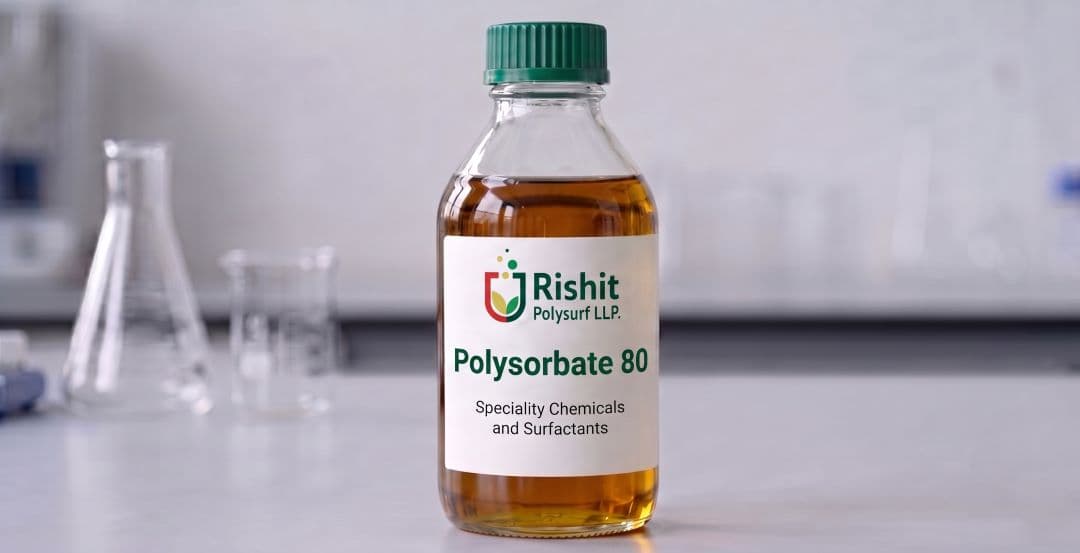
Polysorbate 80
Polysorbate 80 (Tween 80) manufacturer in India — COA, MSDS, and technical support for pharma, cosmetic, food, and industrial buyers. Request bulk pricing.
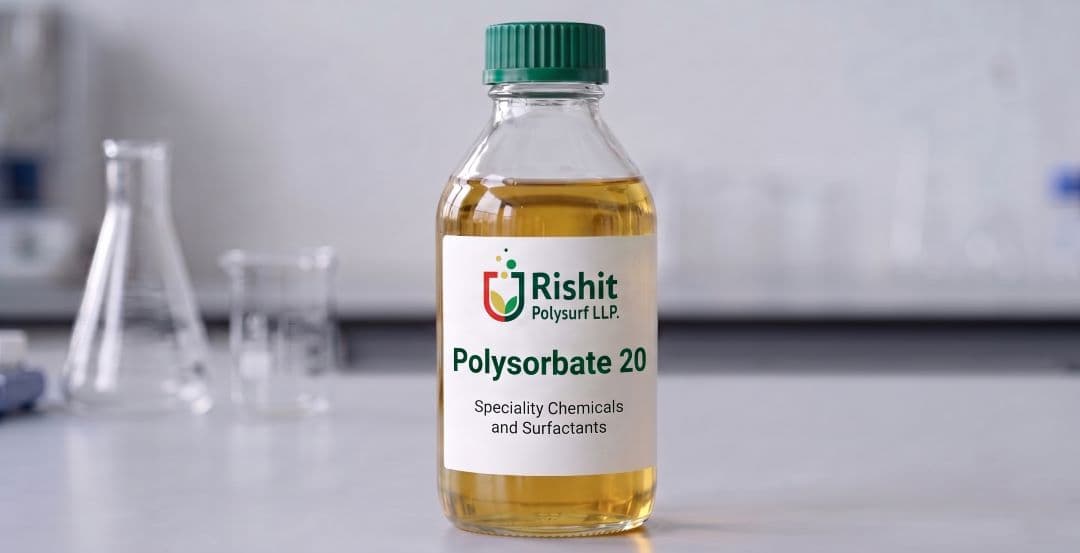
Polysorbate 20
Industrial-grade Polysorbate 20 manufacturer offering consistent quality, technical support, COA, MSDS, and bulk supply for global industries.
Frequently Asked Questions
It is used as a nonionic emulsifier, solubilizer, wetting agent, and dispersing aid across cosmetic, pharmaceutical, and industrial formulations, helping combine water-based and oil-based or hydrophobic components into stable, workable systems.
Yes. It lowers interfacial tension between oil and water phases, supporting the formation and stabilization of oil-in-water emulsions, and depending on the formulation can also solubilize, wet, and disperse.
Yes. It carries no net electrical charge in solution, distinguishing it from anionic, cationic, and amphoteric surfactants and generally supporting broad compatibility with other formulation ingredients.
In cosmetic and personal care formulations, it commonly appears in skincare, creams, lotions, cleansers, shampoos, and body-care products, particularly to solubilize fragrance oils, essential oils, and other oil-soluble components, and to help stabilize oil-in-water emulsions.
It is used for its solubilization, emulsification, and stabilization functions, such as incorporating poorly water-soluble components into aqueous systems. Suitability for any specific formulation depends on the grade used, concentration, formulation requirements, and applicable regulatory and pharmacopeial standards.
The two materials differ primarily in the fatty acid used during manufacture — lauric acid for Polysorbate 20 and oleic acid for Polysorbate 80 — which affects their properties and typical applications. A detailed comparison is available in our Polysorbate 20 vs Polysorbate 80 guide.
Selection should be based on the intended application, required grade, formulation compatibility, and relevant specifications, supported by documentation such as the TDS, SDS, and COA, along with samples for bench-scale evaluation before committing to bulk quantities.